Wind Tunnels - An Introduction #

Photo courtesy of Mercedes AMG Formula 1 Team.
Introductory Thoughts #
An experienced aerodynamicist has a fairly comprehensive understanding of the flowfield around a racecar. But even so, quantiative measurements are often needed to make decisions. A wind tunnel allows for controlled & repeatable testing of conditions seen on a racetrack, but ultimately is still just a model of real world behavior. Like all models, it has its drawbacks.
Why not Simulation? #
Computational fluid dynamics is excellent at rationalizing a particular concept, as it provides unmatched qualitative insights. However, due to limits in computational power, CFD is still only an approximation of flow phenomenon, and is unreliable at predicting behavior at the onset of flow separation or complex turbulent wakes. As some design concepts seek to improve vehicle performance by fractions of a percent at a time, CFD is not always the ideal tool.
Tunnel Details #
At the most basic level, a wind tunnel is an enclosed building with a large fan driving flow through it.
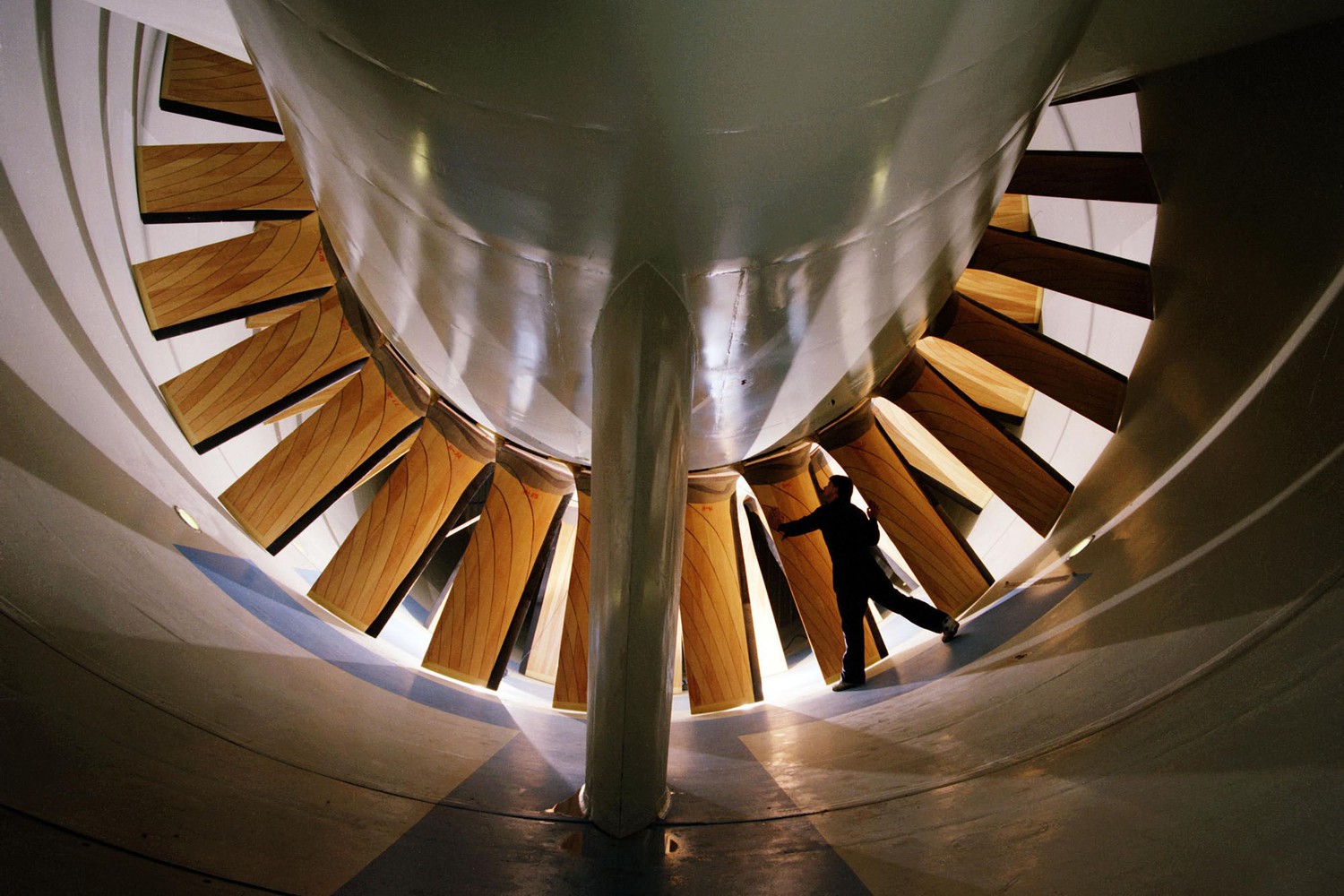
Photo courtesy of NASA.
The test article is placed in open area called the test section. The test section is instrumented to measure forces acting on the article.
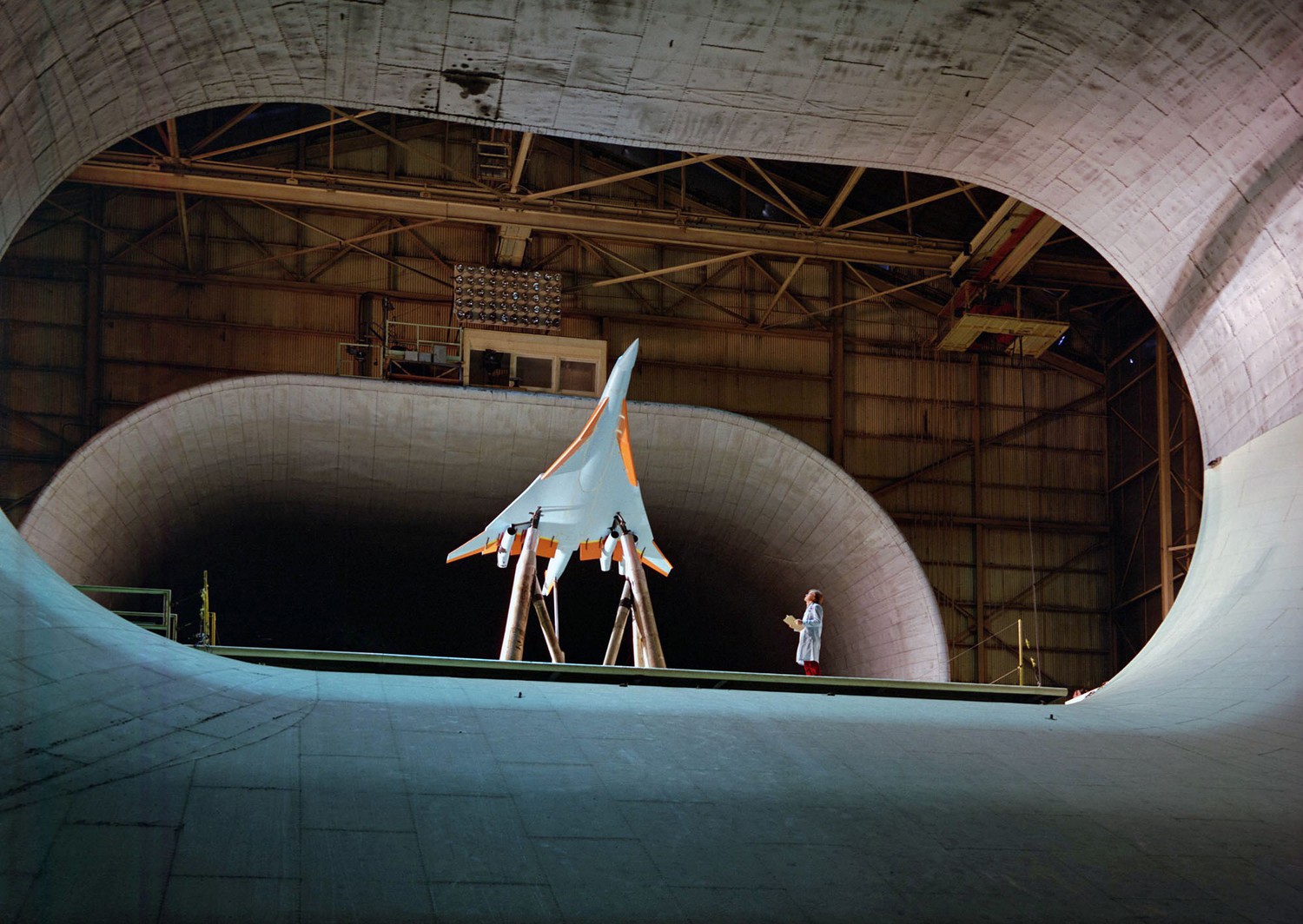
Photo courtesy of NASA.
Beyond this most basic function, not all wind tunnels are built the same. Here are some of the important variances.
Blockage Ratio #
The blockage ratio of test section is the ratio of the frontal area of the vehicle relative to the area of air flowing past the vehicle.
-IMAGE-
This is an important metric because an object effects the flow a fairly large distance around it. If the size of the geometry being tested is too large in relation to the cross sectional area of the wind tunnel, the flow field will incorrectly distort around the body in relation to what would happen on an open road.
As an example, observe how the following flow field changes when the wind tunnel boundaries are too close:
-IMAGE-
Why is every wind tunnel not extremely large so as to prevent this? The answer is cost. For every increment the cross sectional area of the tunnel is increased, more flow has to be accelerated by the fan to fill in this added area. This means initial capital investment in larger fans, and larger operating costs.
It’s not an uncommon sight to see vehicles shoehorned into wind tunnels not meant for them.
Rolling Road #
To accurately replicate on-track conditions, it’s not only the air that has to be forced past the car, the road has to move underneath it as well. Additionally, a rolling road allows the tires to rotate as when the vehicle is in motion. A stationary tire has adverse implications for accuracy, as the rotation influences the shape of the tire wake, which is very significant in every racecar.
The need for a rolling road primarily stems from the incorrect boundary layer formation underneath the vehicle when a stationary flow is used. When ground proximity is low (as it is on a racecar), the results will be entirely incorrect. The is quite a lot of literature on the negative consequences of a stationary floor, and for any vehicle that has any relevant underbody details at all, a wind tunnel without a rolling road is generally not even be considered.
Stationary floor wind tunnels exist because of the large expense associated with the installation and continuned maintainence of a rolling floor system. However, as the primary purpose of using a wind tunnel is to get high fidelity insights, the expense is oit seems illogical to cripple the data with known inaccuracies.
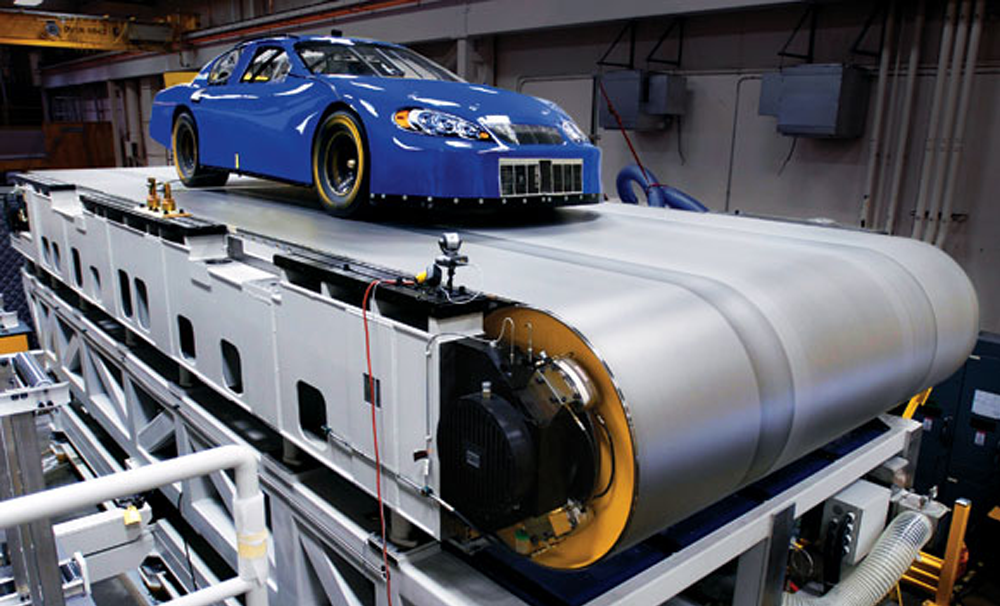
Photo courtesy of the Windshear Wind Tunnel.